

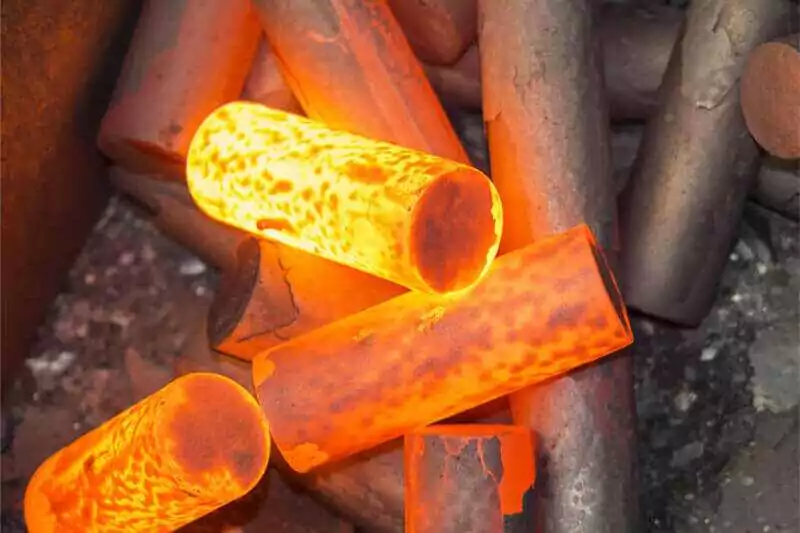
Basic Knowledge and Advantages and Disadvantages of Forging
Forging is the use of machinery to apply pressure to the metal blank so that it produces plastic deformation to obtain certain mechanical properties, shapes, and sizes. The forging processing method is one of the components. Through forging, the casting looseness and other defects caused by the metal in the smelting process can be eliminated. The microstructure structure can be optimized. In addition to that, the mechanical properties of the forging are generally better than the casted parts due to the preservation of complete metal streamlines.
For machinery, important parts with high loads and severe working conditions are mostly forged. This is unless they are plates, profiles, or weldment that can be rolled with simple shapes.
Deformation temperature
The initial recrystallization temperature of steel is about 727 °c, but 800 °c is generally used as the dividing line. The one above 800 °c is hot forging, and between 300 and 800 °c is warm forging or semi-hot forging. Forging at room temperature is cold forging.
Forgings used in most industries are hot forging, warm forging, and cold forging. These forging methods application is in forging parts such as automobiles and general machinery. Warm forging and cold forging can effectively save materials.
Forging Category
As mentioned above, according to the forging temperature, there is hot forging, warm forging, and cold forging. According to the forming mechanism, forging can be divided into free forging, die forging, rolling ring, special forging.
1) Free Forging
Free forging refers to forgings’ processing method that uses simple universal tools. It includes directly applying an external force to the blank between the upper and lower anvils of forging equipment to deform the blank and obtain the required geometry and internal mass. Forgings produced by the free forging method are called free forgings.
Free forging is good for the production of forgings with small batches. The forging equipment such as forging hammers and hydraulic presses are used to form the blanks and obtain qualified forgings. The basic processes of free forging include upsetting, drawing, punching, cutting, bending, twisting, staggering, and forging. Free forging takes the form of hot forging.
2) Die Forging
Die forging is divided into open die forging and closed die forging. The metal blank is deformed by pressure in the forging chamber with a certain shape to obtain the forging. The die forging is generally used to produce parts with small weight and large batches. Die forging can be divided into hot die forging, warm forging, and cold forging. Warm forging and cold forging are the future development direction of die forging and represent the level of forging technology.
According to the material, die forging can also be divided into ferrous metal die forging, non-ferrous metal die forging, and powder product molding. As the name suggests, the materials are ferrous metals such as carbon steel, non-ferrous metals such as copper and aluminum, and powder metallurgy materials.
Extrusion should be attributed to die forging, which can be divided into the heavy metal extrusion and light metal extrusion. Closed die forging and closed upsetting forging belong to the two advanced processes of die forging. Because there is no flying edge, the utilization rate of the material is high. The finishing of complex forgings can complete in one process or several processes.
With no flying edges, the force area of the forging is smaller, and the required load is also smaller. However, it should be noted that the blank cannot be completely limited. So it is necessary to strictly control the volume of the blank, control the relative position of the forging die and measure the forging, and strive to reduce the wear of the forging die.
3) Mill Ring
The ring mill refers to the production of ring parts of different diameters through the special equipment ring-milling machine. The method produces wheel-shaped parts such as automobile wheel hubs and train wheels.
4) Special Forging
Special forging includes roll forging, wedge rolling, radial forging, liquid die forging, and other forging methods, which are more suitable for the production of certain special shapes of parts. For example, roller forging is a good effective performing process to reduce the subsequent forming pressure. Wedge rolling can produce steel balls, transmission shafts, and other parts. Lastly, radial forging can produce large barrels, step shafts, and other forgings.
5) Forging Die
According to the movement mode of the forging die, forging can be divided into pendulum rolling, pendulum rotary forging, roller forging, wedge rolling, roll ring, and oblique rolling. Swing rolls, pendulum swaggers, and rings are good for precision forging. In order to improve the utilization of materials, roller forging and cross rolling are good for pre-processing processing of slender materials.
Rotary forging, like free forging, is also locally formed. Its major advantage is that it can be molded with less forging force than the size of the forging. Including free forging, this forging method, when processing, the material expands from the nearby mold surface to the free surface. Therefore, it is difficult to ensure accuracy. Computers control the direction of motion of the forging die and the rotary swaging process.
The shape of complex and high-precision products can be obtained with a lower forging force, such as the production of forgings such as steam turbine blades with many varieties and large sizes. The mold movement of forging equipment is inconsistent with the degree of freedom and may be divided into the following four forms:
Limit the form of forging force
Quasi-stroke restriction mode
Stroke restriction mode
Energy restriction mode
In order to obtain high precision, take care to prevent overload at the lower dead spot, control the speed and mold position. Because these can all have an impact on forging tolerances, shape accuracy, and die life. In addition, in order to maintain accuracy, pay attention to adjusting the slider rail clearance, ensuring stiffness, adjusting the lower dead spot, and using subsidy transmissions.
There are also vertical and horizontal movements of the slider (for forging of slender parts, lubrication cooling, and forging of parts for high-speed production), and the use of compensation devices can increase the movement in other directions.
The above methods are different. The required forging force, process, material utilization, yield, dimensional tolerances, and lubrication cooling methods are also different. These factors are also factors that affect the level of automation.
Forging Materials
Forging materials are mainly carbon steels and alloy steels of various components, followed by aluminum, magnesium, copper, titanium, and their alloys. The original state of the material is bar stock, ingot, metal powder, and liquid metal. The ratio of the cross-sectional area of the metal before deformation to the cross-sectional area after deformation is called the forging ratio. Correct selection of forging ratio, reasonable heating temperature and holding time, reasonable forging temperature and final forging temperature, reasonable deformation amount, and deformation speed has a lot to do with improving product quality and reducing costs.
Generally, small and medium-sized forgings use round or square bar stock as blanks. The grain structure and mechanical properties of the bar stock should be uniform and good. The shape and size are accurate, and the surface quality is good, which is convenient for mass production of the tissue. As long as the heating temperature and deformation conditions are reasonably controlled, you can forge without large forging deformation.
Ingots are only used for large forgings. Ingots are cast structures with large columnar crystals and loose centers. Therefore, it is necessary to break the columnar crystals into fine grains through large plastic deformation. Then loosen and compact them in order to obtain excellent metal microstructure and mechanical properties.
Powder metallurgy material forging
Powder metallurgy prefabricated blanks formed by pressing and sintering can be made into powder forgings by flyless die forging in the hot state. Forging powder is close to the density of general die forgings, has good mechanical properties and high precision, which can reduce subsequent cutting processing. The powder forgings are evenly organized internally and have no segregation. Therefore, they are good for manufacturing workpieces such as small gears. However, the price of powder is much higher than the price of general rods. Application in production is also limited to a certain extent.
Apply static pressure to the liquid metal poured into the mold chamber so that it solidifies, crystallizes, flows, plastic deformation, and molding under pressure. That way, the desired shape and performance of the die forging can be obtained. Liquid metal die forging is a forming method between die-casting and die forging. It is suitable for complex thin-walled parts that are difficult to form in general die forging.
Other materials
In addition to the usual materials and aluminum, magnesium, copper, titanium, etc., and their alloys, iron-based superalloys, nickel-based superalloys, cobalt-based superalloys of the deformation alloy are also forged or rolled to complete. But these alloys, due to their relatively narrow plastic area, forging difficulty will be relatively large. The heating temperature of different materials, the forging temperature, and the final forging temperature have strict requirements.
Process
Different forging methods have different processes, of which the hot die forging process is the longest. The general order is: forging blanking → forging blank heating → roll forging blank → die forging forming → cutting edge → punching → correction → intermediate inspection, an inspection of forging size and surface defects → forging heat treatment, to eliminate forging stress, improve metal cutting performance → cleaning, mainly to remove surface oxide scale→ correction → inspection. General forgings to go through appearance and hardness inspection. Important forgings also need to undergo chemical composition analysis, mechanical properties, residual stress, and other tests and non-destructive testing.
Forging Features
Compared with castings, forging metals improve their microstructure and mechanical properties. After the casting structure is deformed by the forging method, due to the deformation and recrystallization of the metal, the original coarse dendrites and columnar grains become isotylic recrystallization structures with finer grains and uniform size.
So the original segregation, looseness, porosity, slag clamping, and other compaction and welding in the steel ingots, and its structure becomes more compact. This improves the plasticity and mechanical properties of the metal.
The mechanical properties of castings are lower than those of forgings of the same material. In addition, forging processing can ensure the continuity of the metal fiber structure. So the fiber structure of the forging is consistent with the shape of the forging. The metal streamline is complete, and the forgings produced by precision die forging, cold extrusion, warm extrusion, and other processes guarantee the parts have good mechanical properties and a long service life, which are incomparable to the castings.
Forgings
Forgings are objects where metal is pressure applied to shape the required shape or suitable compressive force through plastic deformation. This force is typically achieved through the use of a hammer or pressure. The forging process builds a delicate granular structure and improves the physical properties of the metal. In the real-world use of parts, a correct design allows particles to flow in the direction of the main pressure.
Casting
Casting is a metal molded object obtained by various casting methods. It involves a smelted liquid metal injected into the pre-prepared mold by pouring, injection, or other casting methods. It is cooled by sand fall, cleaning, post-treatment, etc., the obtained objects with a certain shape, size, and performance.