

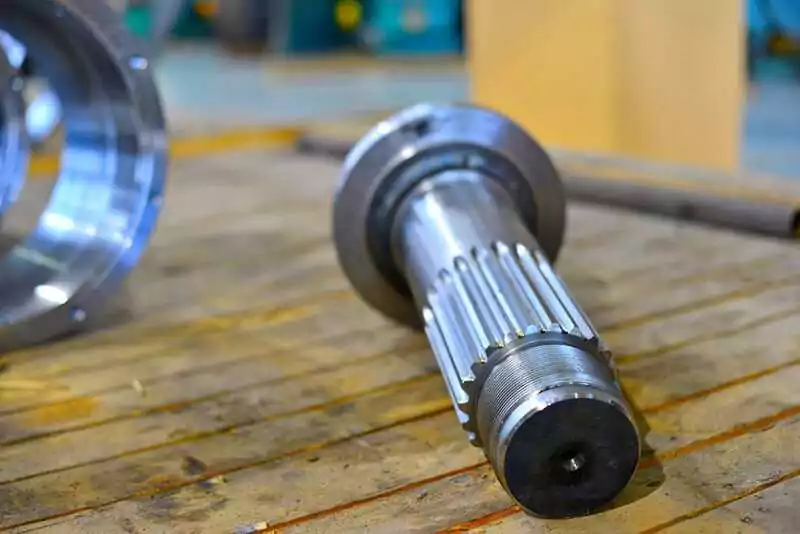
What Are The Concepts And Basic Types Of Spline Shafts?
The spline shaft is a kind of mechanical transmission device that uses splines or ridges and grooves to transmit torque. There are two main types of transmission shafts, with keyed and spline shafts being the most common. The splined has more advantages than the keyed counterparts, including uniform torque transfer.
Spline shafts can also reduce torque transmission and provide equal distribution of the load along with the teeth of the gear. These shafts also experience a longer fatigue life and have better resistance against wear and tear.
The flat key, the half-circle key, and the oblique key are the same, all of which transmit mechanical torque. There is a longitudinal keyway on the surface of the shaft and an equivalent keyway on the rotating part sleeved on the shaft.
The basic concept of spline shaft
- Function:
The main function of the spline shaft is the mechanical transmission of the torque. The male and female versions fit into each other or interlocks to transfer movement. It has the flat key, half-circle key, and oblique key, which all have the same function. They all transmit mechanical torque.
- Structure
The structure of the spline shaft includes a longitudinal keyway on the outer surface of the shaft and the rotating part sleeved on the shaft with a corresponding keyway, which rotates synchronously with the shaft. While rotating, some can also slide longitudinally on the shaft, such as gearbox shift gears.
- Application examples
The spline shaft has vast applications, especially in automobiles. They can be used for applications brakes and steering mechanisms in automobiles. There is also a telescopic shaft, which is composed of inner and outer tubes. The outer tube has internal teeth, and the inner tube has external teeth, which sleeves together to complete the transmission of mechanical torque. When the telescopic shaft is in use, it can extend and contract in the length direction while transmitting the rotating torque.
- Material: 40Cr.
The 40Cr is the steel alloy that is widely used in the machine-building industry. It is the standard grade that has great comprehensive mechanical properties. Its low-temperature impact toughness and hardenability are some of the reasons it is ideal for spline shaft manufacturing. 40Cr can withstand rough and abrasive conditions and offers high resistance to wear and tear. There are many other advantages of this steel alloy that makes it ideal for such products.
- Heat treatment
The heat treatment is crucial for all metallic parts, and spline shafts should go through the same. The hardened surface hardness is HRC45-50. Therefore, you can expect the shaft to deliver incredible mechanical properties. The shaft withstands extremely demanding conditions and has a longer lifespan with proper heat treatment.
Type of spline shaft
There are many types of spline shafts, but the most common ones are the rectangular spline shafts and involute spline shafts. However, the rectangular spline shafts are the most widely used and more so for the typical uses. The involute spline shafts are commonly in larger loads and require high centering accuracy. They also require larger connection dimensions, which makes them a bit complex.
Rectangular spline shafts are common in aircraft, agricultural machinery, automobiles, and tractors. You will also find these shafts in machine tool manufacturing and general mechanical transmission devices. From the design of the rectangular spline shafts, they work with multiple teeth. This is what gives them the high load-bearing capacity, good neutrality, and good guiding.
The shallow tooth root of the rectangular spline shaft can help reduce the stress concentration. In addition, the processing is more convenient. Therefore it is easy to obtain a higher precision by grinding.
On the other hand, involute spline shafts characteristics include. One the tooth profile is involute. The other one is the radial force on the teeth when loaded, which can play a self-centering role. Each tooth is uniformly stressed, has high strength and long life, and the processing technology is the same as that of the gear.
Other types of spline shafts in the market include parallel, crowned, serrations, and helical. All these types have specific use-cases, but the most common are rectangular and involute types. The cold forging and warm forging processes are the popular forming technologies for the spline shafts.